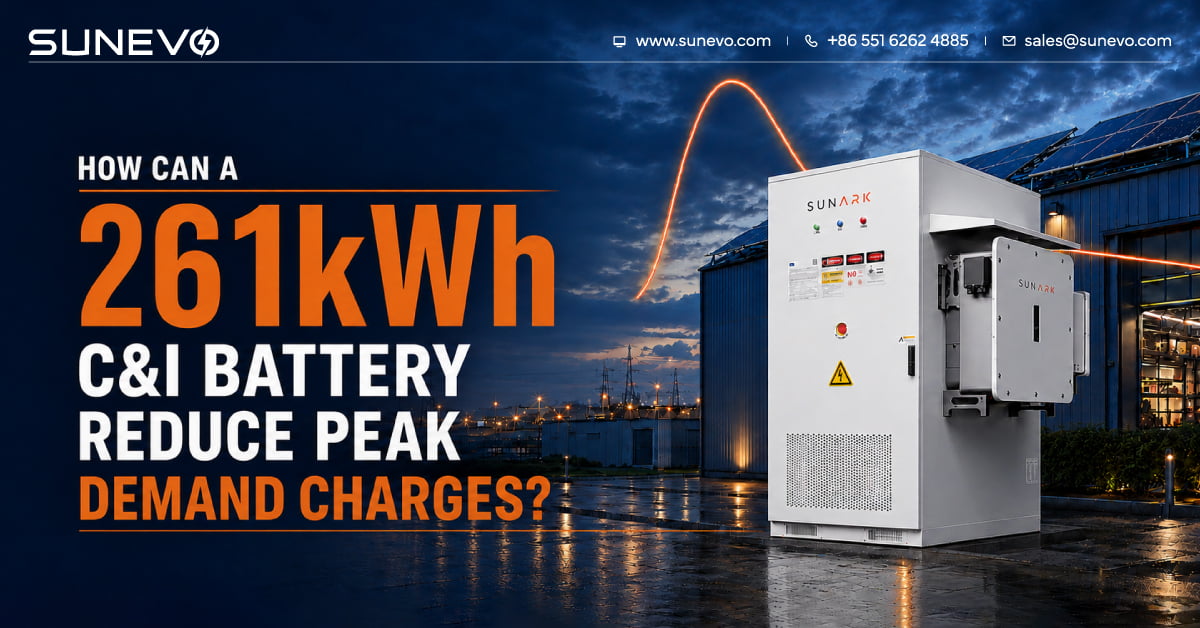
How Can a 261kWh C&I Battery Energy Storage System Reduce Peak Demand Charges?
For many commercial and industrial facilities, peak demand charges account for 30%–50% of total commercial and industrial (C&I) electricity bills for most factories, warehouses, and commercial facilities.
Electricity costs are determined not only by total energy consumption in kilowatt-hours (kWh), but also by the highest level of power drawn from the grid in kilowatts (kW).
This peak demand may occur for only a short period, yet it can significantly increase the monthly electricity bill. A 261kWh commercial and industrial battery energy storage system can help reduce these charges through peak shaving.
What Are Peak Demand Charges?
Peak demand charges are typically based on the highest average power demand recorded during a billing interval, often 15 or 30 minutes, within the billing period.
For example, if several production lines, HVAC systems or EV chargers operate simultaneously, grid demand may rise sharply. Even if this peak lasts for only a short time, the facility may be billed according to that maximum demand level.
Demand charges are measured in kW, while energy consumption is measured in kWh. This distinction is important when sizing a battery storage system.
How Does a 261kWh Battery Reduce Peak Demand?
A C&I battery energy storage system continuously monitors the facility’s electricity demand through an energy management system.
When grid demand approaches a predefined limit, the battery discharges to supply part of the load. This reduces the power drawn from the utility grid and helps prevent a new monthly demand peak.
The operating process is straightforward:
This process is known as peak shaving. The U.S. Department of Energy describes peak shaving as the use of energy storage to reduce peak power demand and avoid demand-related electricity charges. U.S. Department of Energy
Why Power and Energy Ratings Both Matter
The 261kWh rating indicates how much energy the battery can store. However, peak-demand reduction also depends on the system’s power rating.
For example, a 125kW/261kWh C&I battery system can theoretically supply up to 125kW of power while its available stored energy lasts, subject to operating limits, state of charge, conversion losses and reserve requirements.
If a facility needs to reduce a 100kW peak for 90 minutes, the required discharge energy is approximately:
100kW × 1.5 hours = 150kWh
A 261kWh system may be able to support this peak-shaving event if sufficient usable capacity is available. However, it cannot reduce a peak that exceeds the PCS output limit. This is why both the facility’s load profile and the battery’s kW rating must be evaluated.
What Determines the Actual Savings?
The financial result depends on several site-specific factors:
A battery should therefore be sized using interval load data rather than monthly electricity consumption alone.
A simplified estimate is:
Monthly savings = Demand reduction (kW) × Demand charge rate
If the battery lowers monthly peak demand by 80kW and the utility demand charge is USD 15/kW, the estimated gross saving would be:
80kW × USD 15/kW = USD 1,200 per month
This example does not include energy costs, battery losses, degradation, maintenance expenses or tariff-specific conditions.
Where Can a 261kWh C&I Battery Be Used?
A 261kWh C&I battery energy storage system is suitable for facilities with short or recurring demand peaks, including:
Facilities with predictable load peaks and relatively high demand charges generally present stronger peak-shaving opportunities.
Conclusion
A 261kWh C&I battery energy storage system reduces peak demand charges by discharging when facility demand approaches a predefined grid limit. It does not necessarily reduce total electricity consumption; instead, it changes when and how much power is drawn from the grid.
The effectiveness of the system depends on correct sizing, accurate load analysis and a properly configured energy management strategy. Before selecting a system, businesses should review their interval load data, utility tariff, peak duration and required discharge power.



 IPv6 network supported

 français
 Deutsch
 italiano
 español
 português
 العربية
 日本語
日本語 Polski
 ไทย
ไทย